

In today’s fast-paced business world, a reliable and cost-effective communication system isn’t just a tool—it’s a competitive advantage. For companies in bustling markets from New York to Los Angeles, switching to modern solutions like Business VOIP, hosted phone systems, and SIP trunking is the key to unlocking significant savings, boosting productivity, and scaling with ease. A modern cloud phone service transforms your communication from a costly necessity into a powerful asset, enabling seamless collaboration whether your team is in a downtown Chicago high-rise or working remotely across Phoenix.
Why VOIP is a Game-Changer for Your Business
Rising telecom bills can feel like an unavoidable cost, but what if you could turn that expense into a strategic advantage? For businesses in competitive hubs like Houston and Philadelphia, adopting a Business VOIP system isn’t just about saving money; it’s about future-proofing your operations.
Effective telecommunication cost management starts with moving away from outdated, hardware-heavy PBX systems to flexible cloud-based solutions. A hosted phone system gives you a bird’s-eye view of your entire communications setup, from your primary business lines in Dallas to your remote team’s connectivity in Seattle. Without a modern system, you’re likely paying for unused lines, missing billing errors, and stuck with a rigid setup that can’t keep up with your growth.
Beyond Simple Savings with a Cloud Phone Service
The benefits of a structured approach to your telecom services go far beyond the balance sheet. When you embrace a modern cloud phone service, you unlock major operational wins:
- Crystal-Clear Visibility: Gain a complete inventory of all your telecom services, eliminating surprise costs.
- Effortless Scalability: Easily add or remove users as your business evolves, whether you’re expanding your office in San Diego or onboarding remote staff in Austin.
- Enhanced Productivity: Equip your teams with advanced tools like video conferencing, auto-attendants, and mobile apps to improve collaboration.
- Robust Security: Benefit from enterprise-grade security features that protect your data and ensure business continuity.
The push for this technology is clear. The global telecom expense management (TEM) market is surging, growing from $4.09 billion to an estimated $4.72 billion in just one year. This growth is driven by the complexity of modern communications and the universal need for efficiency. You can discover more insights on this market trend.
Ultimately, a modern business VOIP system is about taking back control. It empowers companies in dynamic markets like San Jose and Denver to make smarter decisions, optimize resources, and build a communication infrastructure that’s ready for anything.
Why a Hosted Phone System in Your City is a Smart Investment

The days of a clunky PBX system gathering dust in a server closet are over. Sticking with an outdated phone system is inefficient, costly, and guaranteed to slow you down. Transitioning to a Business VOIP or Hosted Phone System isn’t just an upgrade; it’s a strategic move with immediate impact. Imagine a growing business in Fort Worth or Charlotte expanding its operations without its telecom budget spiraling out of control. That’s the power of the cloud.
The True Cost of Legacy PBX Systems
Traditional PBX (Private Branch Exchange) systems rely on expensive on-site hardware that requires a significant upfront investment and specialized IT staff for maintenance. When a part fails, you’re facing costly downtime—a massive risk for any company, whether it’s a logistics firm in Jacksonville or a financial services group in San Francisco. Scaling a legacy PBX is a logistical nightmare, requiring more hardware and complex installations.
How a Business VOIP in Your City Delivers Immediate ROI
Business VOIP and hosted phone systems operate by sending voice calls securely over your existing internet connection. This simple shift unlocks powerful financial and operational benefits for businesses across the country.
- Predictable Costs in Columbus: Hosted phone systems run on a per-user, per-month subscription, making it easy for a business in Columbus to budget its telecom spend with confidence.
- Reduced Maintenance in Indianapolis: The provider handles all the complex infrastructure in their secure data centers, eliminating the need for you to buy or maintain expensive PBX hardware.
- Enterprise-Grade Features in San Antonio: High-end features like auto-attendants, call analytics, and video conferencing are often included, delivering tremendous value from day one.
A core principle of successful telecommunication cost management is shifting from a capital expenditure (CapEx) model to a predictable operational expenditure (OpEx) model. This change frees up cash and simplifies financial planning.
The scalability of modern telecom is a huge advantage. A tech startup in Austin can add phone lines with a few clicks, using flexible SIP trunking to pay only for the call capacity it needs. Meanwhile, a large enterprise with offices in Washington D.C. and New York can unify its entire network under a single cloud phone service managed from one central dashboard. For more on this, see our guide on IT procurement best practices. This is a proactive approach central to effective telecommunication cost management.
Q&A: Localized Business Telecom Questions
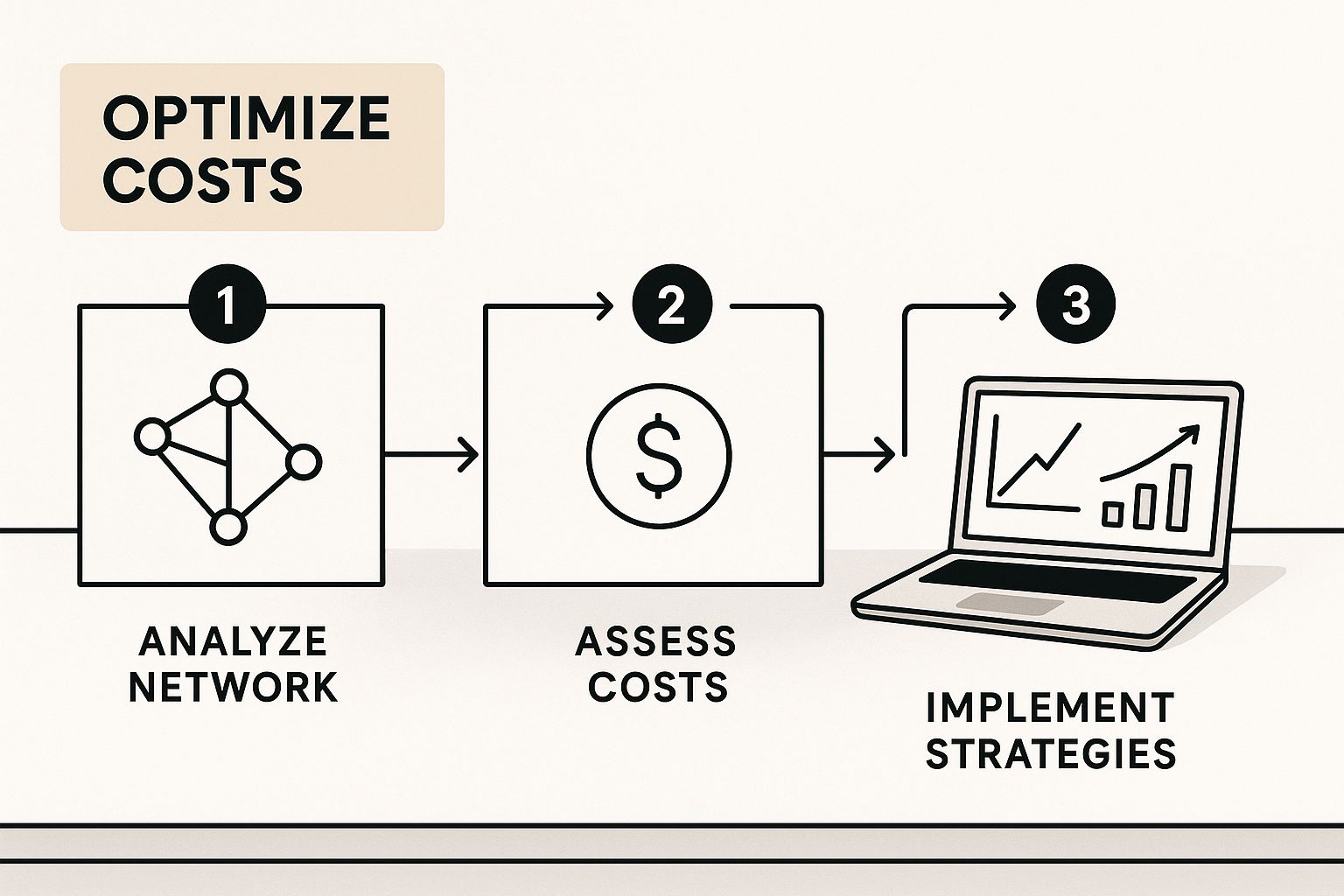
Navigating the world of business telecom can be confusing. To help, we’ve answered some common questions from businesses in major U.S. cities, showing how modern solutions like VOIP and hosted phone systems can address local challenges and opportunities.
Q: How much can my business in New York City save by switching to VOIP?
A: For a business in a high-cost market like New York, switching to VOIP can lead to significant savings, often between 30-50% on your monthly phone bills. These savings come from eliminating expensive physical phone lines, reducing maintenance costs, and getting predictable per-user monthly billing. This consistency is a game-changer for any NYC business looking to manage its budget effectively.
Q: Is a cloud phone service reliable enough for my financial firm in Chicago?
A: Absolutely. For a financial firm in Chicago, where reliability and security are non-negotiable, top-tier cloud phone services are built to meet those demands. The best providers offer 99.999% uptime guarantees, backed by geographically redundant data centers. If your Chicago office experiences an outage, calls are automatically rerouted to mobile devices, ensuring you never miss a critical client conversation. Features like end-to-end encryption also come standard, keeping sensitive information secure.
Q: My tech startup in Austin is growing fast. Can SIP trunking scale with us?
A: SIP trunking is perfect for a fast-growing startup in a tech hub like Austin. Unlike rigid traditional phone lines, SIP trunks are elastic. You can add or remove call capacity channel by channel through a simple online portal. This “pay-as-you-grow” model means your phone system scales in lockstep with your team, ensuring you never waste money on unused capacity—the essence of smart telecommunication cost management. A great starting point for this is a small business phone system comparison.
Q: How does a hosted PBX support our remote team across the Los Angeles area?
A: A hosted PBX, or cloud phone system, is ideal for a distributed workforce in a sprawling metro area like Los Angeles. It extends your professional office phone system to any location with an internet connection. An employee working from home in Pasadena has the same features—call transferring, conferencing, voicemail-to-email—as someone in your downtown L.A. office. They can use a mobile app or desktop softphone to make and receive calls on their business line, maintaining a professional image while keeping their personal number private.
Telecom Needs for Business VOIP Across US Cities

A one-size-fits-all telecom strategy is a recipe for wasted money. The needs of a business are shaped by its location and industry. A financial firm in Philadelphia operates in a different world than a logistics hub in Houston, and their communication systems should reflect that.
North America holds 35.91% of the revenue share for telecom expense management, driven by companies in regulated industries. The U.S. telecom billing market alone is projected to grow from $5.44 billion to $14.99 billion by 2034. You can read the full research on this market growth. This shows that while everyone is managing telecom spend, the how and why differ from coast to coast.
VOIP for Finance and Healthcare Hubs: Philadelphia and Washington D.C.
In cities like Philadelphia and Washington D.C., where finance and healthcare dominate, security and compliance are paramount. A law firm in D.C. can’t tolerate downtime, and a hospital in Philly needs HIPAA-compliant communications.
Their priorities for a business VOIP system include:
- Robust Security: End-to-end encryption and secure data centers.
- High Uptime Guarantees: SLAs of 99.999% are standard.
- Compliance: Providers must meet strict industry regulations.
Cost management here means getting ironclad security and reliability without overpaying. For more details, explore our guide on enterprise network security solutions.
VOIP for Tech and Media Centers: San Francisco and Seattle
On the West Coast, in tech hubs like San Francisco and Seattle, the focus is on flexibility, scalability, and software integration. A startup in Seattle needs a cloud phone service that integrates seamlessly with tools like Salesforce and Microsoft Teams.
The key demand for a hosted phone system in San Francisco or Seattle is for solutions that act like software—flexible, API-driven, and easily embedded into existing workflows.
VOIP for Logistics and Manufacturing Corridors: Houston and Dallas
In the logistics and manufacturing centers of Houston and Dallas, efficiency and cost-effectiveness are king. A distribution center in Houston needs to connect multiple sites into a unified, manageable system. Technologies like SIP trunking are ideal, allowing them to adjust call capacity on demand and pay only for what they use—a perfect example of practical telecommunication cost management. For further reading on this, you can check out business internet options.
At TelcoSolutions, we specialize in simplifying business communications. We work with over 300 providers to find the perfect mix of internet, phone, and network services for your company at the best possible price.
Complete the form below to see how much you could save.