

Let's be real—your telecom expenses are probably bloated. We're talking about hidden fees, billing mistakes, and forgotten services that quietly siphon money from your budget every single month. Telecom expense optimization isn't just about cutting costs; it's a strategic deep-dive to find and eliminate that waste. Think of it as taking back control in a tech environment that's only getting more complex and expensive.
Why Your Telecom Bills Are Higher Than They Should Be
Most businesses overpay for telecom services, often without even knowing it. The culprits are usually buried in convoluted invoices and contracts that haven't been touched in years, making it nearly impossible to spot the red flags.
As your company grows and adds new locations, more mobile devices, and cloud services, this complexity multiplies. Before you know it, you've created the perfect storm for overspending. This isn't just some minor line item—it's a significant operational cost that rarely gets the scrutiny it deserves. The problem has become so widespread that it’s fueled a whole industry dedicated to solving it.
The Surging Need for Telecom Oversight
The growth of the Telecom Expense Management (TEM) market tells a very clear story. Valued at $4.09 billion in 2024, it's expected to jump to $4.72 billion in 2025—a compound annual growth rate (CAGR) of 15.5%.
What’s driving this? Skyrocketing service costs, the explosion of mobile devices in the workplace, and relentless pressure on businesses to be more efficient. Experts are forecasting the market will hit $8.31 billion by 2029, which just hammers home the point that this is a persistent, growing problem. You can get more details on these numbers in the latest TEM market research.
The takeaway is simple: if you're not actively managing your telecom spend, you are almost certainly leaving money on the table.
Common Areas of Telecom Overspending
So, where is all this money actually going? It's rarely one big mistake. More often, it's a "death by a thousand cuts" situation—small, recurring issues that add up to a major financial drain over time.
Here's a quick look at the most common culprits we see inflating telecom bills. This table is a great starting point to diagnose where your own company might be leaking cash.
Common Areas of Telecom Overspending
| Overspending Category | Description | Potential Impact |
|---|---|---|
| Billing Errors | Charges for incorrect rates, taxes, or fees that don't match your contract. These are surprisingly common on complex carrier invoices. | Drains 5-12% of your annual telecom budget on average. |
| Zombie Services | Active services and lines for closed locations, former employees, or temporary projects that were never disconnected. | Unnecessary recurring monthly charges for assets providing zero value. |
| Contract Misalignment | Paying for services based on outdated contract terms or failing to activate more favorable rates that have become available. | Missing out on significant savings and better terms offered to new customers. |
| Underutilized Assets | Paying for more bandwidth, data, or phone lines than your actual usage requires. This is especially common in multi-site networks. | Wasted spend on capacity that your business doesn't need. |
After reviewing thousands of telecom invoices over the years, we've found that these four areas account for the vast majority of overspending. It's a pattern that repeats across industries and company sizes.
The fundamental challenge is a lack of visibility. When you can't see every service, every line item, and every contract term in one consolidated view, it's impossible to manage costs effectively.
This guide will give you a framework to shine a light on these hidden costs. We’ll walk you through a clear, actionable path to audit your network, analyze your spending, and implement optimization strategies that actually stick. It’s time to move from a reactive "bill-paying" mode to a proactive approach, so you can finally get a handle on your telecom budget and reinvest those savings into growing your business.
Building a Complete Telecom Inventory
You can't optimize what you can't see. It's a simple truth, but it’s the absolute cornerstone of any successful telecom expense project. Before you can even think about finding savings or negotiating better deals, you first have to build a complete inventory of every single telecom asset and service your company pays for.
This goes way beyond just glancing at the summary page of an invoice. I'm talking about creating a detailed, centralized record—a single source of truth—that maps out every circuit, data plan, mobile device, and contract across all of your business locations. If you don't have this, you're flying completely blind.
This infographic gives a great high-level view of the process, and it all starts with that critical first step: auditing and understanding what you're currently spending.
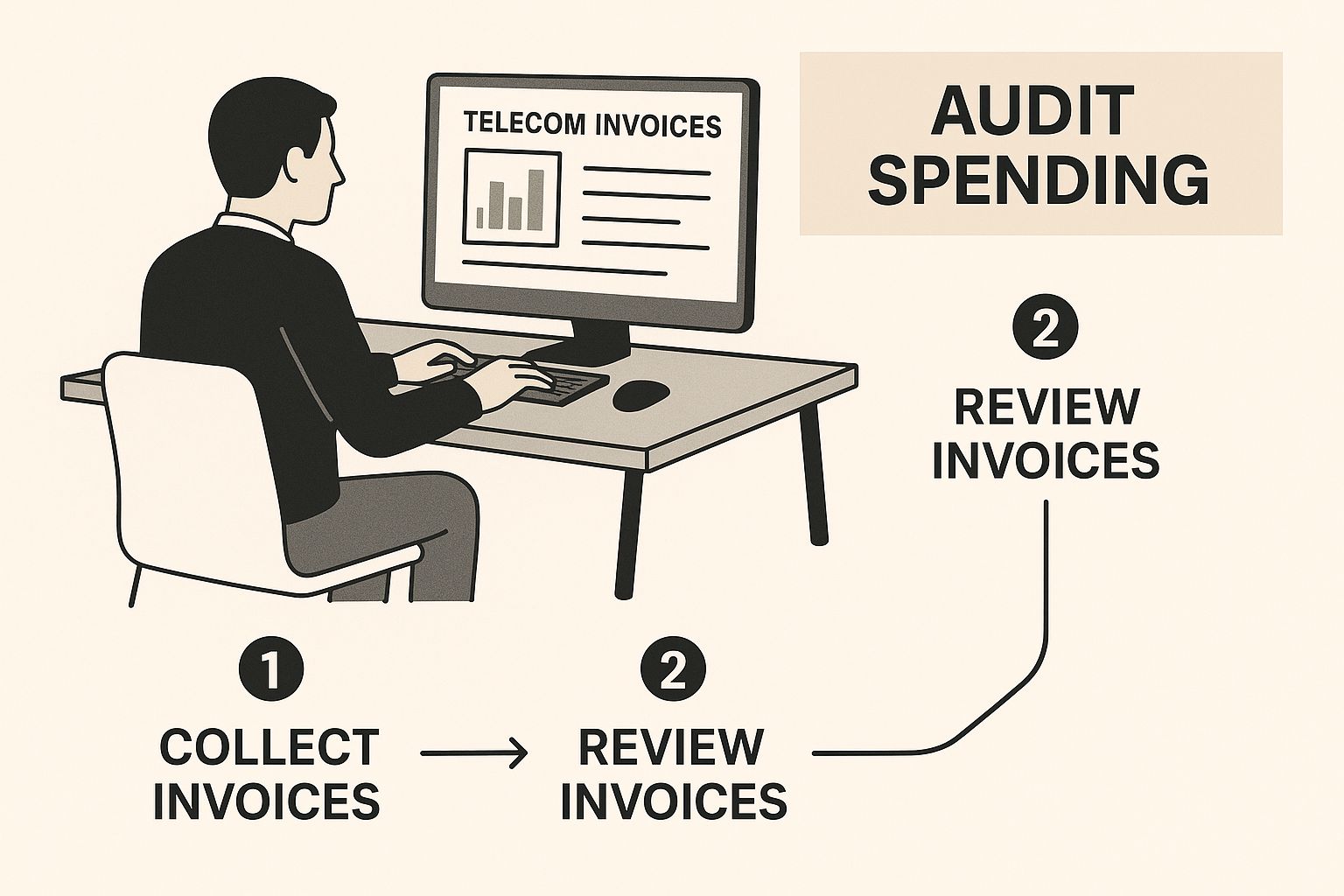
As the visual shows, getting control begins with a thorough review. This sets the stage for building the detailed inventory you'll need to make any real optimization happen.
Gathering Your Data from All Corners
Let's be honest, your telecom data is probably scattered everywhere. It's in different systems, on different documents, and known by different people. Pulling it all together requires a methodical approach to make sure nothing slips through the cracks.
Your first move is to start collecting information from every possible source. I recommend gathering:
- Carrier Invoices: Get your hands on at least three to six months of complete, detailed invoices from every single one of your providers. Don't just grab the summary page; you need the full PDF with all the line-item details.
- Carrier Web Portals: These online portals are often goldmines. They can give you a more dynamic view of your services, including crucial details like circuit IDs, service locations, and active mobile lines.
- Internal Records: Talk to your IT and finance teams. They might have existing spreadsheets, asset management databases, or other internal records related to your telecom services.
- Contracts and Agreements: Dig up all your master service agreements (MSAs) and individual service orders. These documents are where you'll find the specific terms, conditions, and rates you actually agreed to pay.
This initial data-gathering phase can feel tedious, I know. But it is absolutely non-negotiable. Rushing this step will only give you an incomplete picture and lead to missed savings opportunities. Managing a data deep-dive like this can feel like a project in itself. If you need help keeping it organized, our guide on telecom project management offers a solid framework to keep things on track.
Uncovering "Zombie" Assets and Hidden Costs
A thorough inventory process almost always uncovers some surprises. The most common thing we find are what I call "zombie" assets—services that are still active and showing up on your bill but providing zero value to the business.
Here's a real-world example I saw with a national retail chain. During their inventory build-out, they cross-referenced their list of active phone lines against their current list of store locations. The results were pretty shocking.
They discovered dozens of active phone and internet lines for stores that had been closed for over a year. The disconnection requests were never fully processed by the carrier, so the company was bleeding thousands of dollars each month for services at empty buildings.
This is a perfect illustration of the immediate ROI a detailed inventory can provide. These aren't complicated savings to find; they're low-hanging fruit that you can only spot when you have a complete list of what you own versus what you're paying for.
How to Structure Your Telecom Inventory
Once you have all the data, you need to get it organized. A simple spreadsheet might work if you're a smaller organization, but for most multi-site businesses, you'll need a more robust database or even a dedicated Telecom Expense Management (TEM) platform.
At a minimum, your inventory should track these key data points for every single service:
| Data Category | Specific Information to Track | Why It's Important |
|---|---|---|
| Service Details | Circuit ID, phone number, service type (e.g., MPLS, DIA, POTS), bandwidth/speed. | This lets you identify and map every unique service to its specific function. |
| Location Information | Full service address, including suite or floor number. | This links each service to a physical site, helping you spot assets at closed or incorrect locations. |
| Provider & Contract | Carrier name, account number, contract start/end dates, monthly recurring cost (MRC). | This is essential for managing contract renewals and understanding your financial commitments. |
| Internal Context | Department owner, cost center, purpose of the service. | This provides the business context you need for making smart right-sizing decisions. |
Creating this master inventory is the foundational work for everything that comes next. It's what empowers you to audit invoices accurately, analyze usage effectively, and negotiate with carriers from a position of strength, armed with complete and accurate data.
Auditing Invoices and Contracts Like a Pro

With a complete telecom inventory in hand, you’ve officially moved past guesswork and into the investigation phase. This is where the real work begins. Now you can finally compare what you should be paying for with what your carriers are actually charging you.
This process is so much more than a quick glance at the total due. Think of it as a forensic examination of every line item, tax, and fee on your invoices, cross-referenced against your master service agreements (MSAs) and individual service orders. Your mission is to pinpoint every single discrepancy, no matter how small it seems.
Those little errors, which are so easy to overlook, can quickly accumulate into substantial overspending. It’s a shockingly common problem; research shows undetected billing errors are a massive drain on company budgets, often silently bleeding them dry.
Your Audit Hit List
When you dive into a carrier invoice, it’s easy to get lost in the jargon and complex line items. To stay on track, you need a clear "hit list" of common problems to hunt for. You're a detective now, looking for specific clues that something isn't right.
Start by systematically checking for these high-impact issues:
- Rate Discrepancies: Do the monthly recurring charges (MRCs) on the invoice actually match the rates quoted in your contract? A difference of just a few dollars per circuit adds up fast across hundreds of locations.
- Incorrect Taxes and Surcharges: Telecom taxes are notoriously complex and often misapplied. Make sure you aren't being charged for taxes or fees that don't apply to your service type or jurisdiction.
- Miscellaneous "Phantom" Fees: Keep an eye out for vague charges like "regulatory recovery fee" or "property tax allotment." While some are legitimate, others are just inflated or unwarranted additions from the carrier that aren't in your agreement.
- Post-Disconnect Charges: This is a classic "gotcha." You have to cross-reference your inventory with the invoice to ensure you're not still paying for services that were supposed to be disconnected months ago. This happens way more often than you'd think.
By focusing on these key areas, you can methodically work through even the most confusing invoices and build a clear record of every billing error. A disciplined approach to telecom cost management is the only way to make this process effective.
I once worked with a healthcare system that discovered they were being billed for an old T1 data circuit at a clinic that had been upgraded to fiber two years prior. The carrier never processed the disconnect order, costing the organization over $15,000 for a service that wasn't even physically connected anymore.
The Power of Cross-Referencing
Your inventory is your source of truth. Your invoices are the claims made by the carrier. The audit is all about comparing the two, and this is where your detailed inventory truly proves its worth.
For every single line item on an invoice, you should be able to match it to a specific, active service in your inventory. If you find a charge on the bill that doesn't have a home in your inventory, you've just found a potential refund.
Here’s a simple way to organize what you find:
| Finding Category | Invoice Details | Contract/Inventory Details | Discrepancy Amount |
|---|---|---|---|
| Rate Mismatch | Invoice #12345, Circuit ID ABC-001, Charged MRC: $550 | Contract #678, Circuit ID ABC-001, Agreed MRC: $500 | $50/month |
| Zombie Service | Invoice #12345, Phone Line 555-123-4567, Charged MRC: $45 | Inventory: Line disconnected on 03/01/2024 | $45/month |
| SLA Non-Compliance | Invoice #12345, SLA credit due for May outage | Contract: 99.9% uptime guarantee | Credit of $120 due |
This structured approach does more than just identify savings—it builds your case. When you approach a carrier to dispute charges, you can't just say, "I think my bill is too high." You need to present them with organized, undeniable proof.
Having a detailed log with invoice numbers, circuit IDs, and contract clauses gives you the leverage needed to successfully reclaim overpayments. This evidence-based approach transforms your disputes from subjective complaints into factual, data-driven claims that carriers are obligated to address. That preparation is how you get your money back and fix the billing errors for good.
Using Technology for Smarter Optimization
Manual invoice auditing and contract reviews are essential, but let's be honest—they’re also slow, tedious, and a perfect breeding ground for human error. When you're managing hundreds of circuits and mobile devices across dozens of locations, trying to catch every discrepancy with spreadsheets and highlighters is a recipe for missed savings. This is where modern technology completely changes the game for telecom expense optimization.

Automation and artificial intelligence (AI) aren't just buzzwords anymore. They are practical, powerful tools that handle the heavy lifting, freeing up your team to focus on strategic decisions instead of painstaking data entry. This tech allows you to manage costs proactively, not just reactively fix problems after you've already overpaid.
Introducing Telecom Expense Management Platforms
The primary vehicle for this shift is the Telecom Expense Management (TEM) platform. Think of a TEM solution as a centralized command center for your entire telecom world. It plugs directly into your carriers to pull invoice data, automates the audit process, and serves up deep analytics on usage patterns.
Instead of your team spending days poring over PDF invoices, a TEM platform can process them in seconds. It instantly flags billing anomalies, checks line items against your contract terms, and points out potential savings in real time.
Modern TEM solutions use AI to audit every invoice, monitor service usage, and detect billing errors or contract violations before they drain your budget. AI-powered tools are sharp enough to analyze complex telecom contracts and compare them to every single line item on an invoice, finding things like misapplied fees or services you're paying for but not using—the kind of stuff that manual checks almost always miss. You can get a better sense of how the top TEM services are using this technology to drive real results.
From Anomaly Detection to Predictive Insights
The true power of today’s TEM technology goes far beyond just finding billing errors. The most advanced platforms offer predictive insights that help you make smarter decisions about future spending. They don't just tell you what happened last month; they help you forecast what’s coming next.
A great example is managing mobile data usage. Let’s walk through a real-world scenario I’ve seen with a logistics company that had a fleet of 500 delivery drivers, each with a company phone.
The Scenario: Uncovering Hidden Mobile Waste
- The Problem: The company had a one-size-fits-all mobile plan for every driver: unlimited talk and text with a 15 GB data cap. The IT manager had a gut feeling they were overpaying for data but had no efficient way to analyze usage across all 500 devices.
- The Tech Solution: They brought in a TEM platform with AI-driven usage analytics. The platform ingested all their mobile billing data and presented it on a clear, simple dashboard.
- The Insight: The AI tool immediately spotted a pattern. A whopping 73% of drivers consistently used less than 5 GB of data per month, while only a small handful of power users ever got close to the 15 GB limit. The company was paying for a massive amount of data that was going completely unused.
Armed with this insight, the IT manager created a new, lower-cost mobile plan with a 5 GB data cap and moved the majority of the drivers over. This single, data-backed change resulted in a 22% reduction in their monthly mobile spend without impacting performance at all.
This is proactive telecom expense optimization in action. Without that AI-powered tool, this wasteful pattern would have stayed buried in the data forever. The technology didn't just find a mistake; it uncovered a deep inefficiency and provided the hard evidence needed to make a strategic, cost-saving change.
Key Capabilities of Modern TEM Tools
When you're evaluating how technology can help your organization, look for platforms that offer a full suite of features built for comprehensive management.
Core TEM Platform Features:
- Automated Invoice Processing: Say goodbye to manual data entry. These tools digitize and process both paper and electronic invoices automatically.
- Real-Time Anomaly Detection: Get instant alerts for billing errors, random unauthorized charges, and rate plan deviations as soon as invoices come in.
- Usage Analytics and Reporting: Access granular dashboards to visualize data usage, call patterns, and service utilization across your entire organization.
- Inventory Management: This becomes your dynamic, single source of truth for every circuit, device, and contract you manage.
- Contract Management: Never miss a renewal again. The system tracks key contract dates, terms, and deadlines to stop costly auto-renewals at unfavorable rates.
By adopting these tools, you transform telecom expense optimization from a periodic, labor-intensive project into a continuous, automated part of your business operations. This ensures your network isn't just cost-effective today but stays that way as your business grows and changes.
Optimizing Usage and Negotiating Better Contracts
You’ve methodically audited your invoices and built a complete inventory. That was the hard part—finding all the financial leaks. Now it’s time to take what you’ve learned and turn it into tangible savings.
This is where your detailed analysis pays off. We’ll focus on two powerful strategies: fine-tuning how your company actually uses its telecom services and approaching your carriers to negotiate better contracts from a position of undeniable strength.
The data you've gathered is your ultimate leverage. It shifts the conversation with providers from a vague plea for a discount to a fact-based discussion about your real-world needs and current market rates. This is how you achieve true telecom expense optimization.
Right-Sizing Services Based on Actual Need
One of the most common ways businesses overspend is by paying for capacity they simply don’t use. It’s easy to over-provision services "just in case," but that conservative approach can be a massive, silent drain on your budget. Armed with your audit and usage data, you can finally right-size your services with surgical precision.
Here are a few practical ways to align services with actual consumption:
- Roll Out Mobile Device Policies: Create clear, simple guidelines for mobile data. A common-sense rule is mandating that large file downloads or software updates only happen over Wi-Fi. This one policy change can dramatically slash mobile data overage charges across your entire organization.
- Pool Your Data Plans: Instead of managing dozens of individual data plans, talk to your carrier about creating a shared or pooled data plan. This lets high-usage devices draw from the same bucket as low-usage ones, minimizing the risk of costly overages on any single line.
- Re-evaluate Your Bandwidth: Your usage analytics will show you the peak bandwidth consumption for each of your sites. If a location is consistently using only 30 Mbps on a 100 Mbps circuit, you have a clear, data-backed opportunity to downgrade the service and cut the monthly cost without impacting performance one bit.
These aren't about cutting corners; they’re about paying only for what you truly need. This data-driven approach ensures your network stays robust and reliable while eliminating unnecessary fat from your telecom spend.
Preparing to Negotiate with Your Carriers
Walking into a contract negotiation without solid data is like showing up to a final exam without studying. You might get lucky, but you’re almost guaranteed to leave significant savings on the table. Your audit findings and usage reports are the ammunition you need to build a compelling business case for better pricing and terms.
A logistics company I worked with used their audit findings to show their carrier that they were paying 15% above the market rate for their MPLS network. They also identified multiple zombie lines still being billed. By presenting this organized evidence, they successfully negotiated a 20% reduction in their annual contract value and received a credit for the overbilling.
This is the power of preparation. Before you even think about picking up the phone, have your case fully built. This means benchmarking your current rates against industry standards and getting competitive quotes from other providers to introduce a little healthy competition into the mix.
This strategic approach is becoming more critical as the industry evolves. In 2025, telecom providers are laser-focused on moving their own operations and business support systems (OSS/BSS) onto unified, cloud-based platforms. This push is all about streamlining their own processes and cutting their operational expenses. This internal drive for efficiency often makes them more receptive to data-driven negotiations from well-informed customers. You can find more on this in the telecom industry outlook from Deloitte.com.
Executing a Successful Contract Negotiation
When you get your carrier on the line, let the data do the talking. Don’t lead with demands; start by sharing your findings.
Here’s a proven playbook for structuring that conversation:
- Present Your Audit Findings Clearly: Kick things off by walking them through the specific billing errors, zombie services, and contract discrepancies you've uncovered. Have circuit IDs and invoice numbers ready.
- Share Your Usage Data: Show them the reports on underutilized bandwidth or mobile plans. Frame it as an opportunity for them to help you align your services with your actual business needs.
- Leverage Competitive Benchmarks: Casually mention that you've benchmarked your rates and have already received quotes from other providers. You don’t have to be aggressive, but letting them know you’ve done your homework creates a sense of urgency.
- Propose a Win-Win Solution: Instead of just demanding a discount, propose a new contract structure that benefits both of you. For example, offer a longer contract term in exchange for better rates on your most-used services.
By following this evidence-based approach, you transform the negotiation from an adversarial showdown into a collaborative problem-solving session. This not only leads to much better pricing but also strengthens your long-term relationship with your provider.
Answering Common Questions About Telecom Expense Optimization
Even with a solid game plan, putting telecom expense optimization into practice is where the rubber meets the road. This is where you’ll run into real-world questions and practical hurdles. Knowing how to handle these common challenges can be the difference between a stalled project and a massive win for your bottom line.
Let's dig into some of the most frequent questions that pop up during an optimization project. Think of this as your field guide for troubleshooting the process and making sure your efforts pay off.
How Should We Handle Carrier Pushback?
It’s one of the biggest fears for any IT or finance manager: "What if my carrier just says no?" It's a valid concern, but honestly, it’s often overblown. Carriers are businesses, and their goal is to keep good customers. It all comes down to how you approach the conversation.
Don't walk in with vague complaints or general demands for a discount. Instead, you need to show up prepared. Present them with clear, organized evidence straight from your audit.
When you can point to specific circuit IDs with the wrong billing rates or show them hard data on services you're paying for but not using, the dynamic shifts. You're no longer just asking for a better price; you're working together to fix documented errors.
Remember, the goal isn't to create an adversarial relationship. It's to become a well-informed, empowered customer. Carriers are far more willing to negotiate with a client who has done their homework than one who just complains about high bills.
Should We Use Our In-House Team or an External Partner?
Deciding whether to tackle this process internally or bring in a Telecom Expense Management (TEM) provider is a huge strategic choice. There isn't a single right answer here—it really depends on your organization's resources, expertise, and the sheer complexity of your network.
An in-house approach can work just fine if you have a pretty simple telecom environment (maybe just a handful of locations) and a dedicated team with the time and know-how to manage it. The reality, though, is that most internal IT teams are already stretched thin, juggling a dozen other priorities.
On the other hand, partnering with a TEM provider brings specialized knowledge and powerful software tools to the table. This is what they do, all day, every day. These partners can often fast-track your results by using their deep industry benchmarks and established carrier relationships. To get a better sense of what they do, you can learn more about the specifics of telecom expense management in our detailed guide.
How Often Should We Audit Our Services?
Telecom expense optimization is absolutely not a one-and-done project. It’s a continuous cycle. Your telecom environment is always in flux—new sites come online, employees come and go, contracts expire, and new technologies change the game.
As a good rule of thumb, you should plan on a deep, full-scale audit annually. This is your chance for a thorough review of every contract, invoice, and service line item.
Beyond that, you need a process for monthly or quarterly invoice reviews. This more frequent check-up helps you catch new billing errors the moment they appear, before they snowball into significant overcharges. Using a TEM platform can automate a lot of this continuous monitoring, making it far more manageable.
Think of it like car maintenance. You take it in for a major tune-up once a year, but you're still checking the tire pressure and oil levels regularly to prevent bigger problems down the road. This disciplined, ongoing approach is what keeps your telecom spending lean and efficient for the long haul.
Navigating the complexities of telecom contracts and services can be a major challenge, but you don't have to do it alone. TelcoSolutions works with over 300 providers to ensure your business gets the right mix of internet, phone, and network communications at the best possible rate. Find out how we can help you build a communication stack that drives your business forward. Get a better solution with TelcoSolutions.